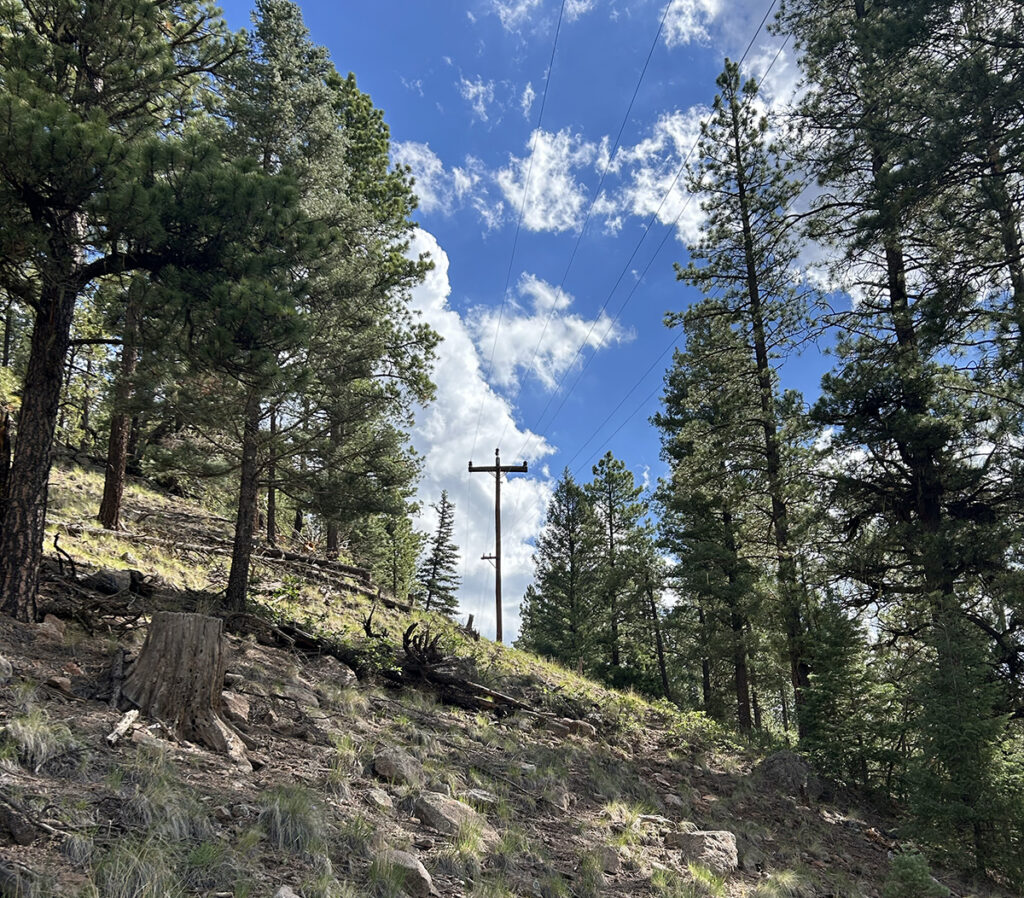
Electric cooperatives and the U.S. Forest Service have teamed up to forge a better path for permitting co-op operations and managing wildfire risk on national forest lands in New Mexico, building on recent progress co-ops have made with federal agencies to support utility operations on public lands.
In late May, the New Mexico Rural Electric Cooperative Association joined leaders from six co-ops and five national forests to sign a new permitting framework that co-ops expect will improve efficiency and lower costs for utility operations in national forests in New Mexico. The document was the culmination of many meetings over a nine-month period, with all 16 New Mexico co-ops approving the guidance and the New Mexico forest division forester endorsing it.
This level of collaboration among co-ops and state and federal partners is “historic,” said Carmen Campbell, grant program manager for Santa Fe-based NMRECA. She expects the new guidance will allow co-ops to perform mitigation work quickly and streamline permit approvals for needed construction, line maintenance and wildfire prevention projects, noting that some co-ops have waited up to five years for permit approvals.
“Everybody understands that the utilities need to get this work done immediately,” Campbell said. “Grid hardening and vegetation management are key drivers in wildfire mitigation.”
Most co-ops in New Mexico have power lines and other infrastructure, including broadband networks, that cross Forest Service lands. A smoother, more predictable permitting process is necessary to support electric reliability and affordability while reducing the risk of catastrophic wildfires.
The new guidance establishes a consistent, statewide approach for operating under power line utility special use permits on Forest Service lands in New Mexico, aiming to avoid inconsistencies among different projects and forest districts.
The guidance seeks to provide consistent permitting language, including on what maintenance activity is deemed an “emergency,” with the goal of expediting crucial vegetation management and power line maintenance operations. Under the new document, co-ops have more authority to determine what qualifies as emergency maintenance so they can perform urgent work more quickly.
The document also streamlines environmental reviews for co-op projects and allows for easier removal of hazard trees that could spark wildfires if they fall from federal land onto co-op lines, Campbell said. It updates the definition of hazard trees to allow co-op staff to certify the presence of such trees without a licensed arborist.
Campbell said some of the measures reflect provisions of the NRECA-backed Fix Our Forests Act, legislation in Congress that seeks to streamline permitting of utility operations and vegetation management on federal lands. The House passed the Fix Our Forests Act in early 2025, with a bipartisan group of senators introducing a companion bill in the Senate.

The New Mexico guidance also would help improve coordination between co-ops and the Forest Service, containing a full list of relevant contacts both at the co-ops and five national forests covered by the framework. The document will be reviewed and updated annually to reflect “evolving operational needs, regulatory considerations and leadership priorities,” the Forest Service said.
Isaiah Romero, CEO of Mora San-Miguel Electric Cooperative in Mora, New Mexico, said the guidance will ease co-ops’ ability to perform emergency restoration work and do projects such as pole replacements in previously disturbed utility rights of way without added red tape and environmental reviews.
The agreement will benefit reliability by allowing co-ops “to do things in a timely manner and not having to wait so long to get all these permits in before we can actually do the work, making our lines safer in the long run,” Romero said.
Along with NMRECA, the document was signed by the heads of Mora San-Miguel EC, Otero County Electric Cooperative (Cloudcroft, New Mexico), Northern Rio Arriba Electric Cooperative (Chama, New Mexico), Jemez Mountains Electric Cooperative (Espanola, New Mexico), Tri-State Generation and Transmission Association (Denver, Colorado) and Kit Carson Electric Cooperative (Taos, New Mexico). Supervisors of the following five national forests also signed the permitting framework: Carson, Gila, Lincoln, Santa Fe and the Cibola National Forest & Grasslands.
The New Mexico agreement follows other recent permitting progress between co-ops and the Forest Service. Earlier this year, Midstate Electric Cooperative in La Pine, Oregon, received several permits to conduct wildfire mitigation projects on federally managed lands. The breakthrough came after Midstate CEO Jim Anderson testified at a House hearing in February on the lengthy delays the co-op faced in getting those permits, leading to discussions between the co-op and the Forest Service on those issues.
After the federal government’s outreach to Midstate, NRECA CEO Jim Matheson wrote to the Forest Service in March urging similar support for all co-ops operating within the national forest system.
“Co-ops across the nation often face months or even years of delays when permitting wildfire mitigation work in and around their systems on federally managed public lands,” NRECA Regulatory Affairs Director Megan Olmstead said.
“It is critical that the Forest Service and Bureau of Land Management expedite these permitting and approval processes and improve consistency and communications between their agencies and regions. Doing so helps improve electric reliability and affordability and can help reduce wildfire risk for communities across rural America.”
Molly Christian is a staff writer for NRECA.