
John Medved of Rappahannock Electric Cooperative has helped restore power after natural disasters and brought electricity to remote communities throughout the world, but he has never faced anything as challenging as the destruction he found in Jamaica when he led a team of volunteer co-op lineworkers to the island after Hurricane Melissa.
“Just flying into Jamaica, you could look down and see that there was no vegetation left on any of the trees, roofs were blown off houses, and debris was everywhere,” said Medved, director-safety and security officer at the Fredericksburg, Virginia-based co-op.
“One child told us that the winds were so strong during the hurricane that it sounded like a lion, and it felt like he was awake in a nightmare.”

Hurricane Melissa was one of the most intense storms ever to hit Jamaica, killing 45 people as it pounded the small island with flooding rains and sustained winds of 185 mph at its peak. The hurricane, which made landfall Oct. 28, destroyed an estimated 75% of the nation’s electrical infrastructure and left most residents without running water as electric-powered pumping stations and treatment plants stopped working.
Jamaica Public Service Company reached out to NRECA International for help, and Medved and 10 other lineworkers from five electric cooperatives throughout the U.S. went to Jamaica from Dec. 1-19 to help restore power to the Discovery Bay area in Saint Anne Parish on the island’s north coast.
In addition to Rappahannock, volunteers came from Choptank Electric Cooperative in Denton, Maryland; First Electric Cooperative in Jacksonville, Arkansas; Northeast Missouri Electric Power Cooperative in Palmyra, Missouri; and Steele-Waseca Co-op Electric in Owatonna, Minnesota.
Another team, with lineworkers from Missouri, is working to restore power to more homes, schools and small businesses in Jamaica this month.
Mike Malandro, president and CEO of Choptank, said it was an easy decision to send four lineworkers to Jamaica when they asked to go.
“If this was happening to us, I would hope that someone would send their crews to help,” he said.
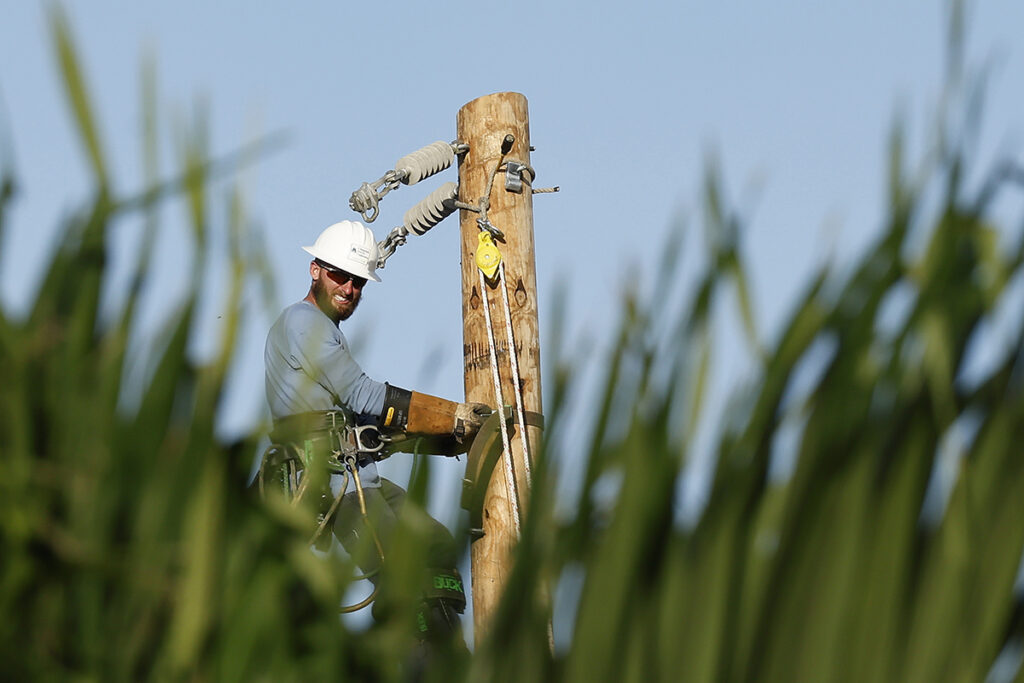
Casey Butler, a chief lineman at Choptank, said he’d never seen people go so long without power after a disaster. He and Medved both volunteered in Jamaica in 2024 after Hurricane Beryl, but the damage was not as severe.
Despite more than a month without electricity, people were incredibly positive, breaking into cheers when the lights came back on anywhere, Butler said.
“In the United States, if the power is out for a day, you know people are going to be aggravated,” he said. “But the Jamaican people were super grateful for what we were doing. You’re not going to break Jamaica; people there were always in good spirits.”
Discovery Bay resident Dyane Reynolds was ecstatic at the thought of getting the power back on in her neighborhood.
“Oh my God, we’re going to have cold water … we’re going to have the [washing machine], we’re going to have the TV, we’re going to have everything we need to be comfortable again, to be back to normal.”

Bradie Boothe said he’d been spending about 4,000 Jamaican dollars—a little more than $25 in U.S. currency—every two days to pay for gas for a generator to power his home after the storm. He had to dip into his savings to fuel the generator since both he and his wife worked in the tourism industry, which came to an abrupt halt after the hurricane. There are so few visitors now that the volunteer lineworkers slept in a vacant hotel.
“Having reliable power back is a gamechanger for everybody,” Boothe said. “Petro has been so expensive. The return of power is a huge relief on everybody’s pocket.”
One of the biggest challenges for the volunteer lineworkers was patching electric infrastructure back together without a fleet of bucket trucks or other standard equipment and supplies. Jamaica Public Service had a bucket truck that they used at times, but most of the work involved climbing poles.
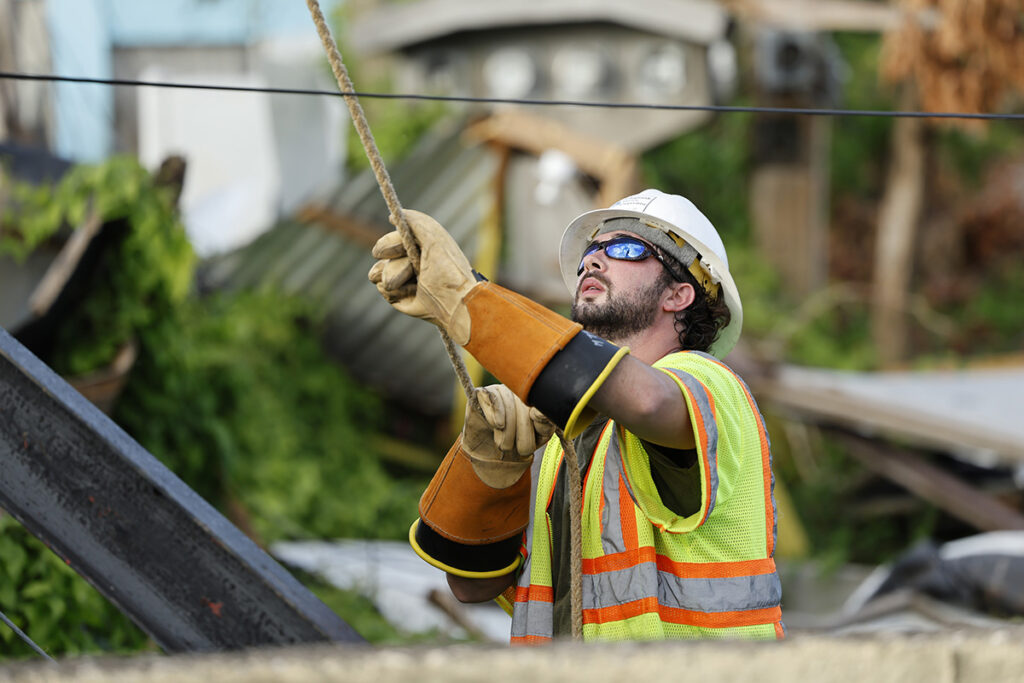
“It shows you can do a lot with almost nothing, using material from poles blown down on the ground,” said Jeff Thomas Jr., a chief lineman at Choptank. “We did a lot of recycling of materials and wire.”
Local residents pitched in by loaning the volunteers their extension ladders and bringing them jerk chicken and other local delicacies for lunch.
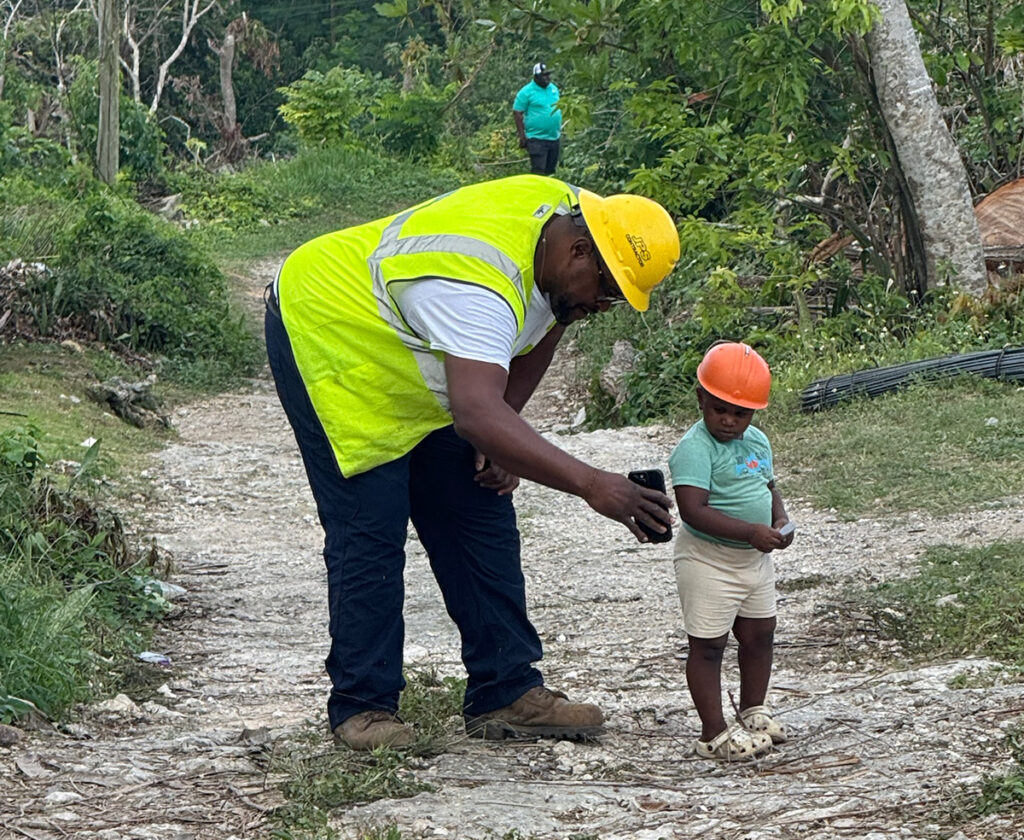
Calvin Jackson, a lead lineman at Rappahannock, had a tiny helper—a little boy, 3 or 4 years old, who came out of his house with his dad to watch the linemen work.
“He had his own little hard hat and plastic hammer, and he grabbed my hand,” Jackson said, chuckling. “He was going to work with me that day.”
Dean Samuel Jr., a Choptank serviceman, said he was impressed by how residents patched their partial roofs back together as best they could. They even invited neighbors to move in with them if the neighbors’ homes were in worse shape, he said.
“They made it work,” Samuel said.
The Jamaicans’ resiliency inspired the volunteers, said Jordan Watson, a journeyman lineworker for Choptank.
“It makes you want to work that much harder and put in the effort to get power back on for as many people as possible,” he said. “We estimated that we turned on power to about 800 to 1,200 meters in three weeks. We put a little dent in the big picture. If you can get one meter on, you’re changing people’s lives.”
Erin Kelly is a staff writer for NRECA. Chad Simon is a communications specialist at Sam Houston Electric Cooperative in Texas and accompanied the volunteers for a portion of the NRECA International trip to Jamaica in December.