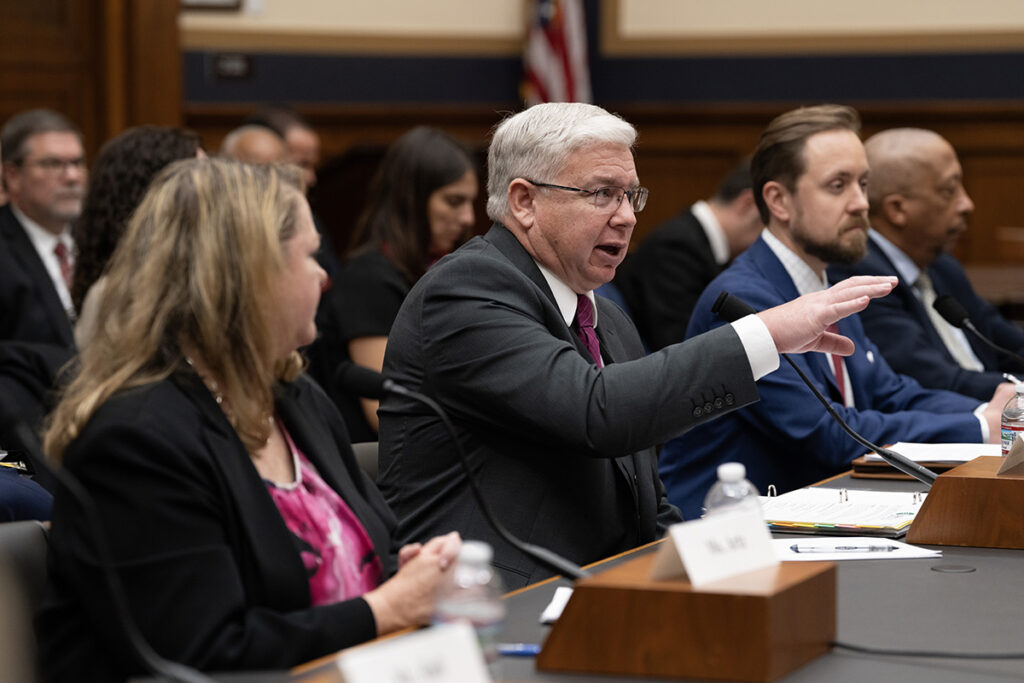
Electric cooperatives are working together on innovative ways to strengthen their cybersecurity, but they can’t do it alone, a Kentucky co-op leader told a House panel Tuesday.
“Smart, targeted federal support through funding, workforce development and improved threat intelligence sharing is essential,” Tim Lindahl, president and CEO of Kenergy Corp., testified at a hearing of the House Energy and Commerce Subcommittee on Energy.
“This will help close the resource gap and ensure rural communities are not left behind in the national effort to secure our energy infrastructure.”
Specifically, Lindahl asked lawmakers to reauthorize the Department of Energy’s Rural and Municipal Utility Cybersecurity Program and release its remaining funds. RMUC, a $250 million, five-year program authorized by Congress through fiscal year 2026, represents what he called “a generational opportunity to improve the cybersecurity posture of electric cooperatives and municipally owned electric utilities.”
“RMUC prioritizes co-ops with the greatest need of support that serve the nation’s most critical infrastructure, including military installations, to help them make the necessary investment to secure the grid,” Lindahl said.
Last fall, DOE announced $80 million in RMUC funding that will directly support more than 400 electric co-ops’ cybersecurity programs.
“Much of that funding has yet to be released to the award winners,” Lindahl said. “We encourage DOE to move expeditiously to distribute the awarded funds so that electric cooperatives can put them into action to defend their critical infrastructure.”
Electric co-ops face unique challenges in securing the grid because of their rural, often remote, locations and the fact that they are not-for-profit businesses, he said.
“Because cooperatives operate without shareholders or profit incentives, financing costly investments often requires reliance on debt, which must be approved by their boards and is ultimately paid back through rates paid by their members,” Lindahl explained, adding that one in four households served by co-ops earns less than $35,000 a year.
“These resource constraints can make it difficult to invest in advanced technologies and recruit and retain a skilled cyber workforce necessary to defend against increasingly sophisticated cyberattacks, especially those from nation-state actors.”
Despite these obstacles, co-ops are uniting to do everything they can to improve their cyber readiness, said Lindahl, whose Henderson-based co-op serves over 60,000 homes and businesses.
“Co-ops across the country are coming together and thinking innovatively to overcome these challenges,” he said. “The seven cooperative principles, like concern for community and cooperation among cooperatives, are the driving force behind what we do.
“Additionally, our national trade association, NRECA, is leveraging private and public dollars to develop cybersecurity tools and resources to improve information sharing, deploy new technologies and build a capable workforce.”
Among those tools, he said, are the NRECA Threat Analysis Center, a secure technology platform that helps the co-op community detect, analyze and communicate cybersecurity threats, and the Co-op Cyber Goals Program, which helps co-ops improve their cyber defenses.
Electric co-ops are committed to doing their part, but collaborating with the federal government remains crucial, Lindahl said.
“With continued partnership and targeted investment, we can strengthen our defenses, protect critical infrastructure, and keep the lights on for 42 million Americans. The last two decades have seen significant advancement in how electric cooperatives secure our grid, but there is much more work still to do.”
Erin Kelly is a staff writer for NRECA.