Regulatory approval of a large solar-plus-storage energy project moves Kaua‘i Island Utility Cooperative significantly closer to achieving Hawaii’s requirement for 100% renewable generation by 2045—all while saving members hundreds of millions of dollars.
The Hawaii Public Utilities Commission on March 5 greenlighted AES Hawaiʻi’s Kaawanui Solar project. The Lihue-based cooperative has signed a 25-year fixed-price power purchase agreement with AES for the project to meet 17.5% of its annual load, which equates to powering about 16,000 homes.
KIUC estimates that the PPA will save the co-op and its members $365 million over the course of the contract.
Beginning in 2030, residential co-op members can expect to see their bill reduced by $4.26 per month, a savings that will rise to about $21.08 per month in the last year of the PPA.
David Bissell, KIUC president and CEO, sees the agreement as key to delivering affordable and reliable energy to co-op members while meeting its renewable energy goals.
“When KIUC was formed in 2002, our rates were by far the highest in the state of Hawaii and among the highest in the nation,” Bissell said. “Due to our journey to achieve 100% renewable generation, our rates are now often some of the lowest in the state of Hawaii, and are much more stable. The Kaawanui Solar project will contribute even further to this progress.”
AES Hawaiʻi will build and operate the project, KIUC’s largest to date. It involves a 43-megawatt photovoltaic array and four hours of lithium-ion battery energy storage systems that can store 172 megawatt-hours of dispatchable energy.
Bissell said KIUC routinely operates solely on renewables on sunny days, but its “main challenge in reaching the state’s mandate of 100% renewable by 2045 is eliminating our fossil fuel use during non-solar periods. Projects like this are critical to reaching that goal.”
KIUC will decommission two outdated substations and build a modern switchyard, Kaawanui Substation, to connect the new solar-plus-storage project to the grid.
Making members aware of the numerous benefits of meeting demand by low emission resources goes a long way toward taking a project such as this to the finish line, said Bissell.
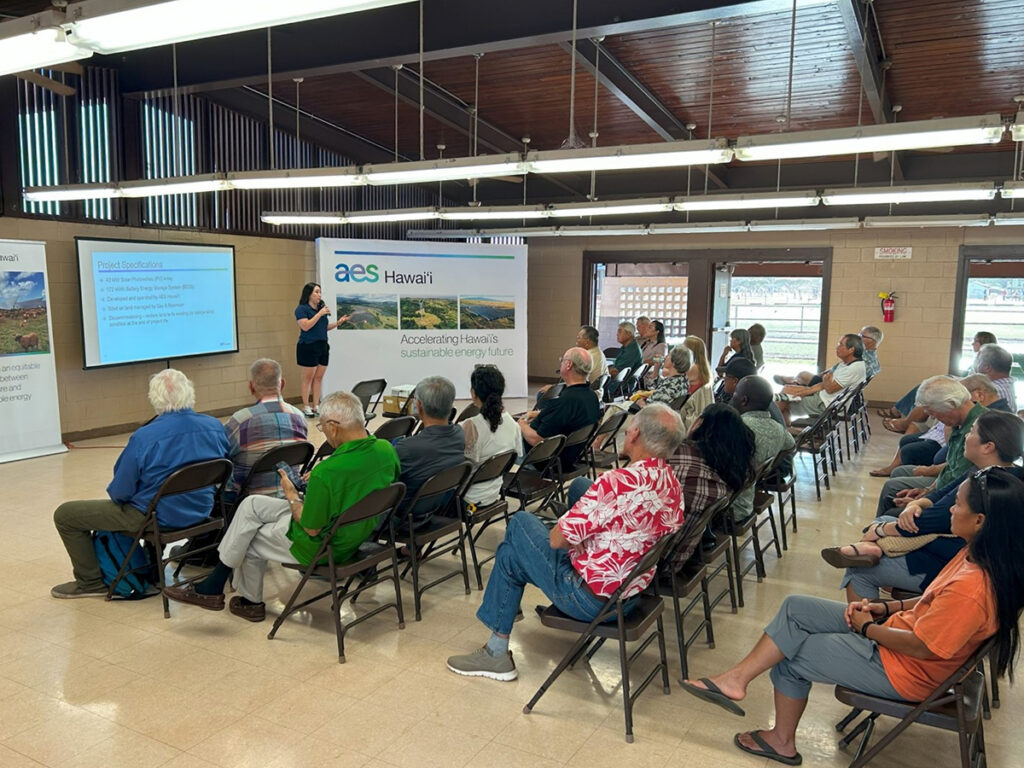
“Large-scale renewable projects such as this one can also help to stabilize rates, provide jobs, improve economic activity, and support local agriculture,” he said. “KIUC and AES Hawaiʻi have held multiple outreach events to gather input from community members and answer questions about the project, which has helped inform the best approach for success.”
The co-op projects that more than 179 million gallons of fossil fuel will be offset through the life of the PPA and about 2.3 million metric tons of carbon dioxide emissions will be avoided.
Cathy Cash is a staff writer for NRECA.