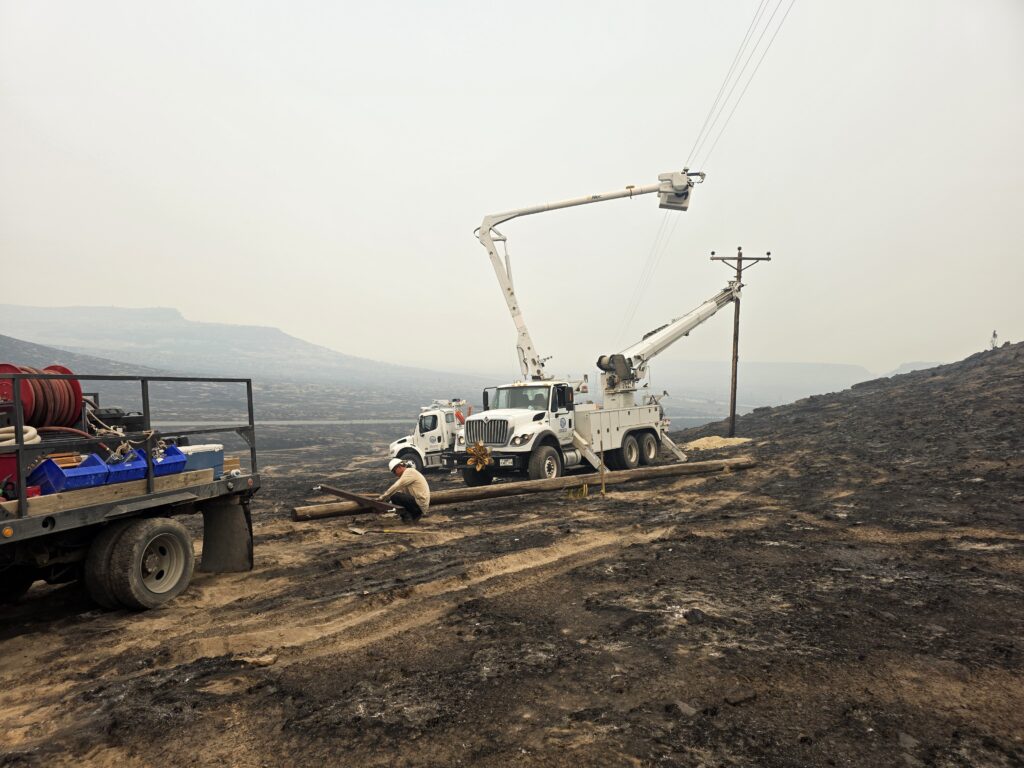
As massive wildfires scorch the Pacific Northwest, electric cooperatives have been working tirelessly to keep the power on for their members even as some co-op employees have lost their own homes to the flames.
At Inland Power & Light Company in Spokane, lineworkers worked 36-hour shifts as three major fires—known collectively as the Spokane Complex—burned through the northern part of the city starting Aug. 1, destroying more than 10,000 acres.
“All of our guys want to be out there as long as they can helping our members,” said Jennifer Lutz, the co-op’s president and chief operating officer. “That’s why we have mandatory rest after 36 hours or they’d never go home.”
The fires affected the co-op’s power supplier, Bonneville Power Administration, causing the bulk of the 10,000 outages that the co-op faced at the peak of the disaster, Lutz said. The co-op, which serves nearly 50,000 meters, also lost about 145 power poles.
More than 40 lineworkers rushed to replace about 50 poles a day and, by the evening of Aug. 5, power had been restored to all the co-op’s members, Lutz said.
But the fire’s impacts went far beyond outages. More than 700 homes have burned down throughout the Spokane community, including 67 owned by Inland Power members. Two of those homes belonged to co-op employees, who were among more than a dozen staff members evacuated from their houses.

“One of our employees who lost her home was our dispatcher,” Lutz said. “We had to pretty much tell her to get out of her house and evacuate. She was on a shift from home that first Saturday and she was in the zone doing her job and wasn’t aware of how fast the fire was spreading toward her home.”
The co-op’s permit coordinator also lost her home. She is staying with her two dogs in an Airbnb while the dispatcher, who has an 18-month-old baby, is staying with friends, Lutz said.
“They seem to be doing well,” she said, adding that the co-op is raising money to help them rent temporary homes while they wait to rebuild. “They are just thankful that they and their families are all OK.”
Despite the stress of keeping the power on during the ongoing wildfires, the disaster has brought out the best in the co-op staff, Lutz said.
“Honestly, I think our co-op and all co-ops shine the brightest during storms and disasters,” she said. “We band together.”
In Oregon, the state’s smallest electric co-op, Columbia Power Cooperative in Monument, is doing just that. Its tiny staff of 10 people has united to keep the power on for 1,100 members as their territory is threatened by three wildfires burning hundreds of thousands of acres.
“It started on the night of July 15 when one of those unprecedented electrical storms came through Oregon and hung in the area for about 24 hours,” said General Manager Lisa Atkin. “There were 9,000 touch downs of lightning in that 24-hour period, so it was inevitable that there would be fires. It was an amazing show of strength by Mother Nature, but it was not one we welcomed.”
When the fires are raging, the co-op’s four linemen try to get out in front of the blazes and go pole-by-pole to remove any vegetation that might catch fire, Atkin said.
“If the poles do catch fire, they will get in behind the fire and use their high-pressure sprayers to extinguish the flames,” she said. “That way, we can replace the poles later and we’re not dealing with immediate outages.”
The co-op’s members appreciate that, Atkin said, because it’s irrigation season for crops, which include hay grown to feed cattle in the winter. The cattle ranches also need electricity to power the pumps that provide water to their herds.
“One cow can drink about 30 gallons of water per day so, if you can’t pump water in these extreme temperatures, the cattle are really going to suffer,” Atkin said.
Firefighters using helicopters, planes and trucks also desperately need well water to help them douse the flames, said Fred Flippence, general manager of Harney Electric Cooperative in Hines, Oregon, which serves 1,244 members in Oregon and Nevada in a territory the size of West Virginia.
“All the water that is needed for fire suppression comes from pumping it out of the ground,” he said. “So, for us, it’s very important to get the power back on.”
Despite facing seven separate wildfires burning hundreds of thousands of acres, the co-op lost power to only about 100 meters for less than 24 hours, Flippence said.
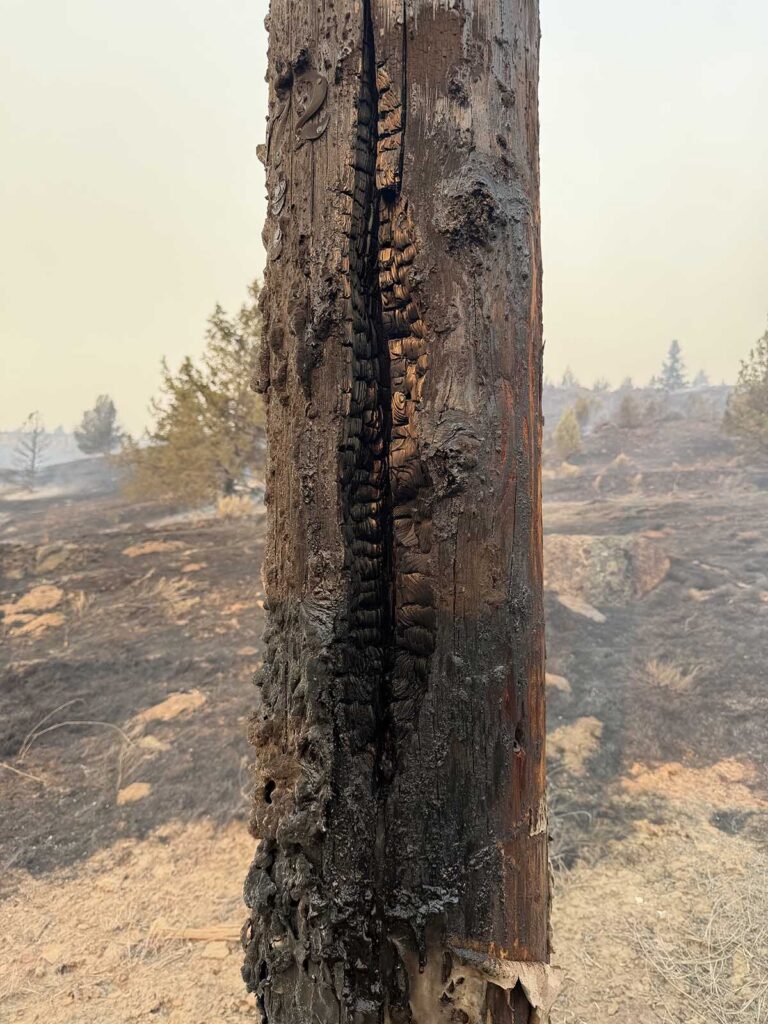
“We lost, in different areas, a little over 50 distribution poles, creating outages,” he said. “The largest outage we had started about 10:30 p.m. and we didn’t get the power back on until about 3 or 4 p.m. the next day.
“We had to wait until the fire could burn through the rest of our line so we could get there. We’re dealing with a grass fire, which is different from a forest fire. We can get right in behind it and build everything back. Our guys are out there, covered in ash, doing a fantastic job.”
When they had time between erecting new power poles, the co-op’s 10 linemen joined the fire lines to help firefighters battle the flames, Flippence said. Because of the prevalence of wildfires in the region, the co-op’s crews are equipped with four fire truck pumpers and trained in wildland firefighting.
“When you’re a co-op, the people you serve power to are your neighbors and friends,” Flippence said. “You do whatever it takes to help them out.”
Similarly, Atkin said her staff has been working nonstop, racking up more than 700 hours of overtime in two weeks.
“They are exhausted, but they are staying in high spirits,” she said. “They’re amazing.”
Atkin is also grateful to Douglas Electric Cooperative in Roseburg, Oregon, for sending four of their lineworkers with bucket trucks and other equipment to help replace transmission poles that were badly damaged by the fires.
“They doubled our number of lineworkers by coming,” she said. “We don’t have the big cranes and tall bucket trucks, so we leaned on them for help and we are so thankful they came.”
After calming down a bit last week, two of the wildfires threatening the co-op have flared up again, creating a new emergency for the line crew to respond to, Atkin said. By Monday, the co-op was down to just two linemen, with one out sick and another working with firefighters to battle the flames closing in on his own home.
“Things change fast in fire season,” Atkin said. “It’s the constant, turbulent nature of summer for us.”
Erin Kelly is a staff writer for NRECA.