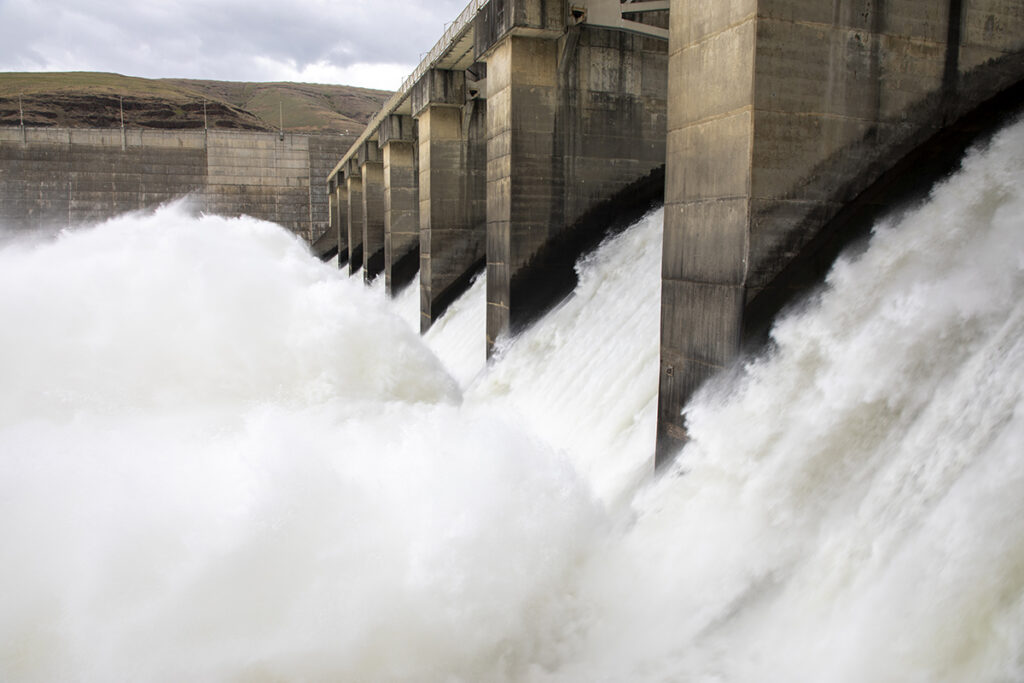
NRECA is supporting efforts to halt an Oregon District Court decision that the federal government says will cause “irreparable harm” to electricity consumers in the Pacific Northwest, including cooperatives served by the Lower Snake River dams.
The association filed an amicus brief April 8 backing the government’s request to stay the court injunction, which limits dam operations along the Columbia and Snake River dams. Almost 90% of the federal Bonneville Power Administration’s electricity supply comes from the Columbia River hydropower system, which serves over 50 electric co-ops across eight states.
“Increases in BPA’s operational and environmental compliance costs and disruptions in power supply will increase costs of electricity and threaten some of the most cost-sensitive regions in the nation,” NRECA said in its amicus brief filed with the U.S. Court of Appeals for the 9th Circuit.
The Trump administration estimates that the District Court injunction will increase BPA’s electricity rates by more than 6% and raise the risk of blackouts by up to 13% during peak demand periods. Such costs are “shouldered by the rural Americans NRECA’s members serve,” the filing stated, calling the lower court’s action “unlawful” and urging the 9th Circuit to stay the injunction.
Earlier this year, the District Court granted a request from environmental groups, tribes and the states of Washington and Oregon to change operations along the dams to protect fish species in the river system. According to the Department of Justice’s stay request, the District Court required “high, continuous” water releases, or spills, at eight dams on the Columbia and Snake rivers, including elevated spills through August and September.
Spill is water released from a dam through the spillway instead of through powerhouses.
BPA expects the court’s ordered spill levels will result in a loss of 1,000 megawatts on average in August and 500 MW in September.
“Absent a stay, the elevated spill levels will cause irreparable harm to the public by increasing the cost of electricity, reducing grid stability, and substantially increasing the risk of blackouts,” the Department of Justice said. “Blackouts in neighborhoods disrupt communities, blackouts in hospitals cost lives, and blackouts in military installations threaten national security.”
NRECA echoed the Justice Department, stating that the District Court lacked the authority to design and impose a new operations plan for the dams and that the court-imposed operational limits violated with the Administrative Procedures Act.
“The District Court approved mandates that may undermine a system powering 4.9 million homes—relief that could never be granted on the merits of the underlying APA and [Endangered Species Act] claims,” NRECA said in its amicus brief.
The brief is the latest step in NRECA and Pacific Northwest co-ops’ work to protect the Lower Snake River dams, which together can produce over 3,000 MW of reliable, affordable and carbon-free hydropower capacity.
In December, NRECA filed an amicus brief with the Oregon District Court in support of the government and our members.
The association has also frequently engaged with President Donald Trump’s team and federal agencies, including the White House Council on Environmental Quality and the National Energy Dominance Council, on the need to preserve the dams. That advocacy was instrumental in overturning a 2023 memorandum from the Biden administration that paved the way for breaching the dams.
CEO Jim Matheson has also testified before Congress on the importance of the dams, highlighting their value to energy production, agriculture, transportation and rural communities. And grassroots network Voices for Cooperative Power engaged co-op consumer-members in the Pacific Northwest to advocate for the dams.
Molly Christian is a staff writer for NRECA.