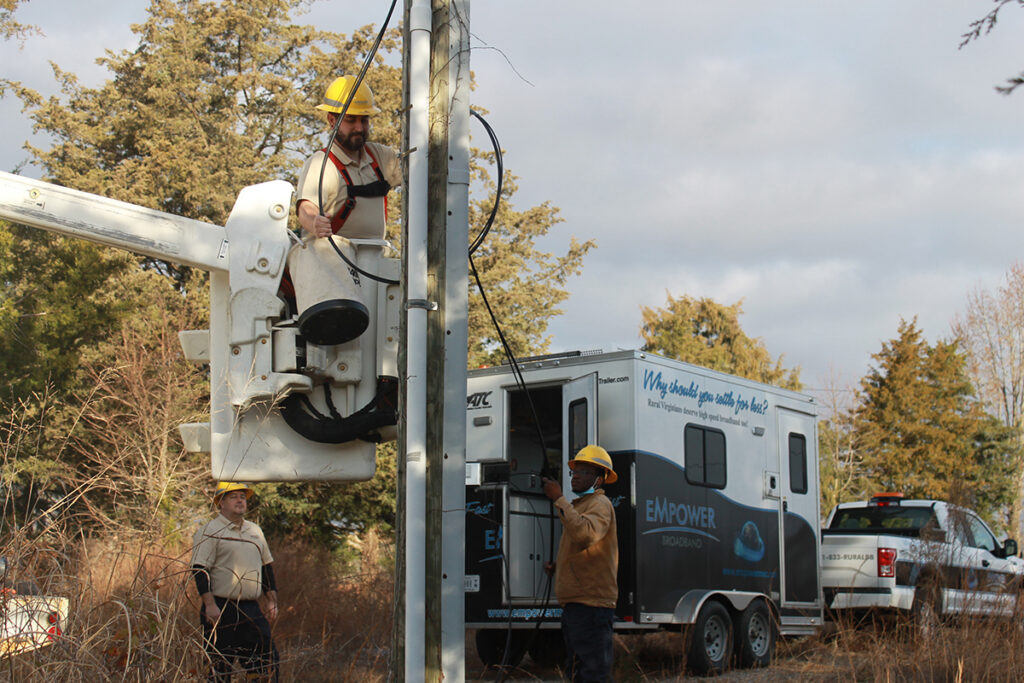
NRECA is urging the Trump administration to overhaul implementation of the $42.5 billion Broadband Equity, Access and Deployment program to ensure BEAD meets its statutory goal to connect every American home and business with reliable, high-speed internet.
The National Telecommunications and Information Administration announced a new round of available BEAD funding on Sept. 3 that NRECA CEO Jim Matheson said continues the program’s “misguided” approach that could leave rural communities behind.
“BEAD’s initial investment is failing rural America,” Matheson said. “Delayed implementation, shifting guidance, cost constraints and unrealistic funding assumptions have slowed progress, discouraged participation and weakened a historic opportunity to bring long-overdue broadband service to rural communities.
“Directing further investment under the same misguided approach will not deliver universal connectivity to rural America.”
BEAD, created through the bipartisan infrastructure law of 2021, provides grants to states to build broadband networks in unserved or underserved areas, including rural parts of the country. The funding can then go to broadband provider subgrantees such as electric cooperatives. Over 200 co-ops are involved in broadband deployment and bringing internet to almost 2 million rural homes and businesses nationwide.
Since the program’s creation, 63 electric co-ops across 27 states have received provisional BEAD awards to serve some of the most challenging locations.
But nearly a third of those co-ops have withdrawn from the program and many others are considering pulling out due to delays and rule changes that “have created a program defined by uncertainty and confusion,” Matheson said in a Sept. 16 letter to Commerce Secretary Howard Lutnick.
One of co-ops’ key concerns is the late addition of a requirement that specifically targets electric co-ops. The requirement subjects co-ops to Federal Communications Commission pole attachment rules, rates and timelines—regulation from which they are statutorily exempt—for their entire electric systems, not just their BEAD project footprint. The requirement is a significant regulatory overreach and a clear break from long-standing federal policy, according to NRECA.
“Instead of accelerating deployment, continual revisions to the program have discouraged participation,” Matheson said.
In his letter, Matheson made several recommendations to ensure BEAD fulfills its mission to deliver internet service to all Americans:
- Increase cost thresholds for BEAD-supported projects to better reflect rising equipment and labor costs and supply chain issues.
- Raise the percentage of project costs that can qualify for exemptions and remove the $1 million project cost cap from Build America Buy America requirements.
- Remove extra-statutory mandates, such as requiring utility pole owners to adhere to FCC pole rules.
- Allow states to include permitting application, platform and tool modernization costs in BEAD administrative budgets or use part of their nondeployment funds to modernize and streamline those systems.
- Ensure any remaining BEAD money invested in pole replacements maintains electric safety and reliability and remains free of any extra-statutory requirements.
The recommendations come as NTIA implements BEAD’s initial deployment phase, starts the new supplemental funding process and weighs possible nondeployment uses of program money.
“NTIA must allow flexibility for cost increases created by program delays, align funding levels with the actual cost of deploying broadband infrastructure in America’s hardest-to-reach communities and remove fatally flawed pole attachment rules that clearly break from long-standing federal policy,” Matheson said. “Without correcting course, BEAD risks leaving rural America behind.”
Molly Christian is a staff writer for NRECA.