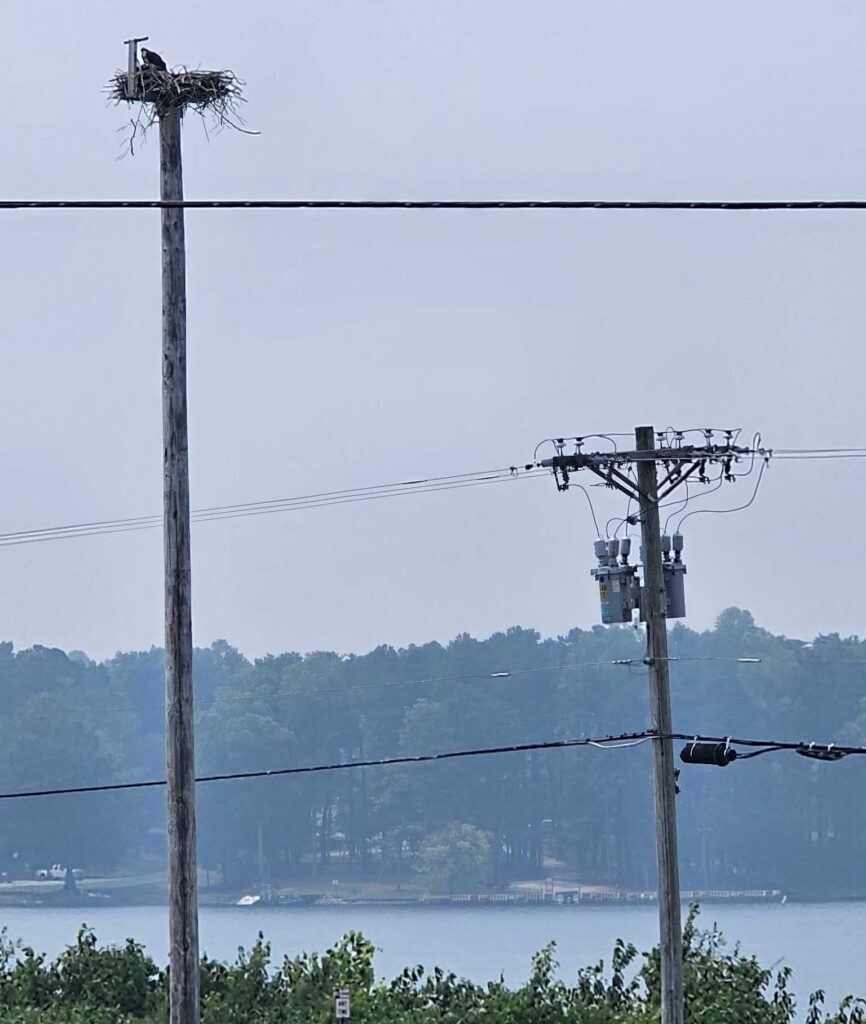
When a pair of ospreys set their sights on a piece of prime waterfront property atop a power pole at North Carolina’s Hyco Lake this spring, Piedmont Electric Cooperative crews faced a two-pronged challenge familiar to many electric cooperatives: protecting wildlife without sacrificing reliability.
The co-op’s solution was to install a nesting platform atop a new pole, luring the birds away from the three-phase breaker pole where they had been building a nest.
“The new nesting platform allowed us to respect and protect the ospreys while also reducing the risk of future outages for members living in the area around Hyco Lake,” said Jarrod Kilgore, vice president of engineering and operations.
It’s the seventh time the co-op has relocated a nest over the past few years at the lake in an effort to address outage issues. Falling sticks from a nest on a pole last year contributed to a two-hour outage and caused flickering lights for about 300 members.
Line Technician Kevin Snead notified management in late March about the latest instance of birds carrying sticks to the top of a pole. Ospreys—large, slender hawks that typically weigh 3 to 4 pounds and have a wingspan of more than 5 feet—are protected by the federal Migratory Bird Act. That law makes it illegal to capture the birds or move active nests without a federal permit.
“Nests are considered inactive up until the point that it has eggs in it,” Kilgore said. “Luckily, in our case we were able to catch it early enough before they were able to fully complete their nest.”
Wanting to act before the raptors laid eggs, the co-op worked with Utility Service Agency, a representative of more than two dozen manufacturers. The company’s solution: a separate nesting pole with a platform tall enough to encourage the birds to move away from energized lines.
“It’s hard to deter them, so sometimes the best case is to give them a better option,” said Chris Rogers, a territory manager.
While the co-op was finalizing its course of action, a stick from the nest fell on a phase, causing another outage. Crews restored service and installed rubber hoses on the lines for temporary protection until they created a permanent plan.
“When that circuit went out, we all immediately knew,” said Jeff Young, a construction supervisor.
To encourage the osprey pair to choose the new option, crews installed a taller pole—55 compared to 35 feet—with a roost about 10 feet from the existing pole. “A little starter kit” of twigs and sticks from the old platform helped settle the birds, Young said.
Developed over two weeks, the strategy worked. “No sooner had we racked up the trucks and pulled off the road, the ospreys flew up there and sat down on the new platform,” Young said.
The story has a happy ending. Last week, Snead spotted chicks in the nest, about 6 to 8 inches tall.
“It felt really good because we knew they wanted to live there,” Kilgore said. “We were like, ‘Let’s work together and figure out how we can be good community partners and good stewards of our wildlife.’”
Victoria A. Rocha is a staff writer for NRECA.