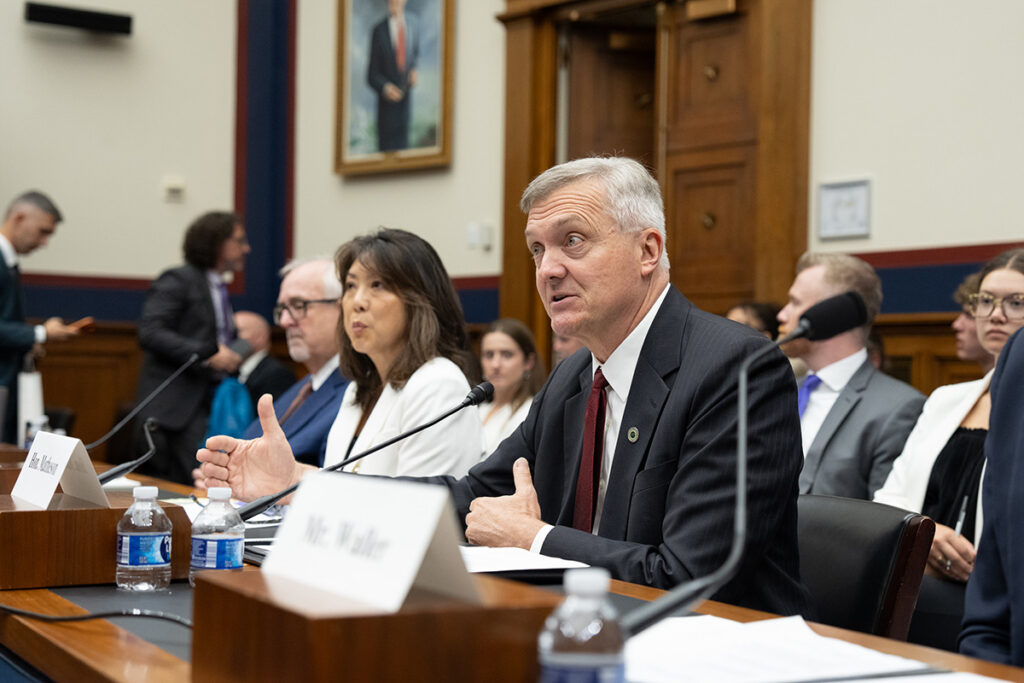
NRECA CEO Jim Matheson, testifying before a House panel Wednesday, urged Congress to pass legislation that would streamline the Federal Emergency Management Agency and dramatically speed up delivery of crucial relief funds to electric cooperatives devastated by natural disasters.
“Congress should pass the FEMA Act quickly so rural families, farmers and businesses are not left behind when the next disaster hits,” Matheson told members of the House Transportation and Infrastructure Committee at a hearing on FEMA reform.
The committee voted last September to advance the bipartisan Fixing Emergency Management for Americans (FEMA) Act with support from NRECA. Committee leaders and NRECA advocates are pushing House leaders to bring the bill to the floor for a vote this year. The Senate must also act for the bill to become law.
The FEMA Act would continue the agency’s critical Public Assistance program, which Matheson called “a lifeline for electric cooperatives after natural disasters.”
“Every year, co-ops lose poles, transformers, power lines, substations and other critical infrastructure to ice storms, tornadoes, floods, hurricanes, wildfires and other events,” he said.
The legislation would also help cut through the red tape that can delay recovery for co-ops and the rural communities they serve, Matheson said.
“While the FEMA-co-op partnership is essential, it can work better,” Matheson said. “Funding approvals involving FEMA and state coordination often take years … These delays slow recovery, strain rural systems, prolong outages and increase costs for consumer-members already facing tight budgets.
“NRECA strongly supports the FEMA Act because it offers specific, practical solutions to these problems.”
He said the bill would provide improvements aligned with NRECA’s five top FEMA reform priorities, which aim to “make FEMA faster, more transparent, and more effective for cooperatives and the communities that depend on reliable power.”
Those five priorities are:
- Better accounting for localized but costly damage that shatters rural communities but may not meet state or county thresholds for disaster declarations because the areas are sparsely populated. Without relief, co-op consumer-members are forced to bear the full cost.
- Reducing the time required to receive Public Assistance. For emergency work to restore power and remove debris, the bill would establish a 120-day reimbursement timeline. For long-term repairs to critical infrastructure, it would create a streamlined, upfront approval process.
- Directing FEMA to reimburse co-ops for the interest they must pay on loans they take out to rebuild their systems while waiting for FEMA to provide relief. Without this reimbursement, co-ops may be forced to pass on interest costs to their members.
- Allowing co-ops to create stronger, more resilient systems instead of being required to replace damaged infrastructure exactly as it was before the disaster.
- Protecting co-ops and their members against FEMA returning long after a disaster to take back relief funds. Matheson said co-ops “have a strong record of stewardship of taxpayer dollars, but arbitrary clawbacks years after a storm create uncertainty and threaten affordability.”
Erin Kelly is a staff writer for NRECA.