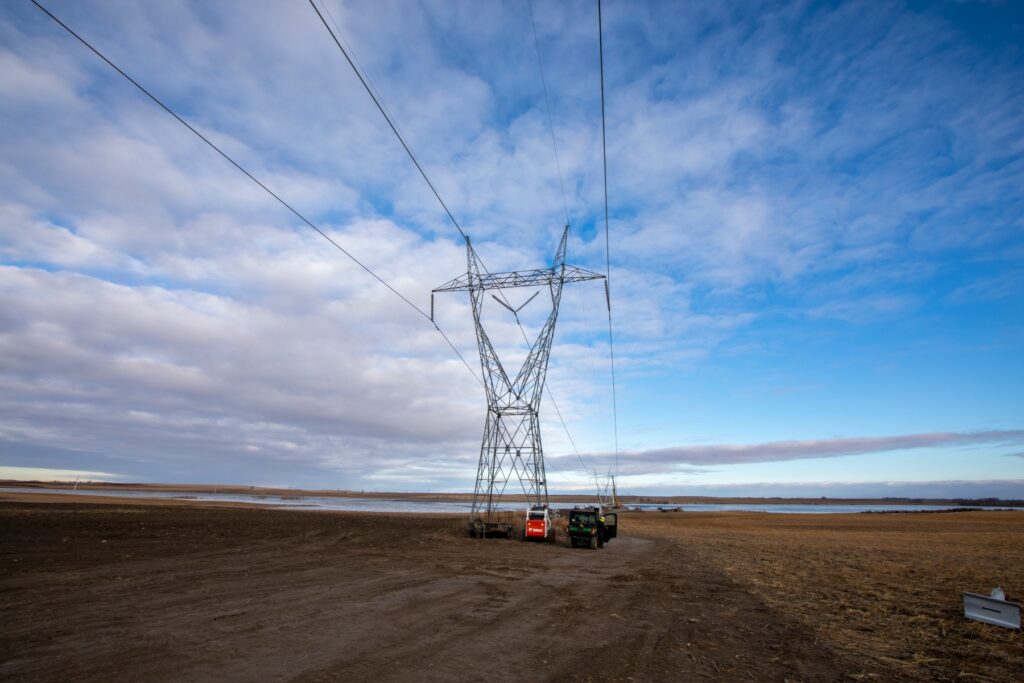
Electric cooperatives have secured more than $200 million in federal funding to build and upgrade transmission infrastructure through the third round of the Department of Energy’s $10.5 billion Grid Resilience and Innovation Partnerships (GRIP) program.
The new round, dubbed the Speed to Power Through Accelerated Reconductoring and Other Key Advanced Transmission Technology Upgrades (SPARK) initiative, will provide $87 million to a consortium made up of NRECA, Basin Electric Power Cooperative and four other co-ops to make transmission infrastructure improvements across a half-dozen states. Another six co-ops that were not part of the consortium were selected for $145 million in SPARK awards.
“Electric cooperatives are making substantial investments to strengthen the electric grid, which is critical to providing reliable and affordable power in rural communities,” NRECA CEO Jim Matheson said. “These project funds will help co-ops get more capacity from existing transmission infrastructure while improving reliability and supporting economic growth.”
The $87 million SPARK award will support the Unified Vision for Energy Resilience project. The NRECA-backed consortium is made up of five co-ops that will cover the remaining costs of the $174 million project: Basin Electric (Bismarck, North Dakota), Cooperative Energy (Hattiesburg, Mississippi), Dairyland Power Cooperative (La Crosse, Wisconsin), NW Electric Power Cooperative (Cameron, Missouri) and Withlacoochee River Electric Cooperative (Dade City, Florida).
The project consists of five transmission system upgrades across Arkansas, Florida, Missouri, Mississippi, North Dakota and Wisconsin that will reduce transmission congestion and increase power transfers from low-cost generation.
The additional co-op projects selected for SPARK funding are:
- 1803 Electric Cooperative (Baton Rouge, Louisiana): Smart grid modernization program to deploy advanced transmission technologies.
- Arizona Electric Power Cooperative (Benson, Arizona): Reconductoring of existing transmission lines, substation equipment upgrades and other work to increase transmission capacity.
- Farmers’ Electric Cooperative of New Mexico (Clovis, New Mexico): Transmission line replacements, swapping wooden infrastructure for steel structures, and deploying advanced communication and control technologies.
- Four County Electric Membership Corp. (Burgaw, North Carolina): Transmission line and substation equipment upgrades and replacing aging wooden transmission line structures with steel structures.
- Kit Carson Electric Cooperative Inc. (Taos, New Mexico): Transmission line upgrades and implementation of a transmission line rating system using advanced sensors and data analytics.
- Powder River Energy Corp. (Sundance, Wyoming): Transmission line upgrades, new real-time measurement sensors, operations automation, and adding artificial intelligence models for operations planning and predictive maintenance.
Overall, SPARK will support 31 grid improvement projects across 26 states with $1.9 billion in total federal funding.
The SPARK awards follow two previous GRIP rounds in which NRECA-led consortia were chosen for around $200 million in federal funding for projects totaling $337 million. The WARN consortium, composed of 35 co-ops, was awarded money under GRIP’s first round for wildfire mitigation projects across the country. The second round of GRIP provided funds for the START consortium to build, rebuild or reconductor transmission infrastructure and increase electric transfer capacity through advanced overhead conductors.
Altogether, more than 80 co-ops have received at least one GRIP award across the three rounds. Federal support for co-ops through the program so far has totaled $1.3 billion for a combined DOE and co-op investment of $2.3 billion.
The awards reflect NRECA’s work with co-ops across multiple administrations to ensure they could successfully compete for federal funding opportunities, protect access to critical programs and keep projects moving forward.
“We are grateful for our partnership with the Department of Energy that is helping co-ops deploy solutions to meet the nation’s growing energy needs,” Matheson said.
Molly Christian is a staff writer for NRECA.