For Middle Tennessee Electric lineworkers Jerry Bartley and Dan Bonds, the “uh-oh” moments of Winter Storm Fern came brutally fast.
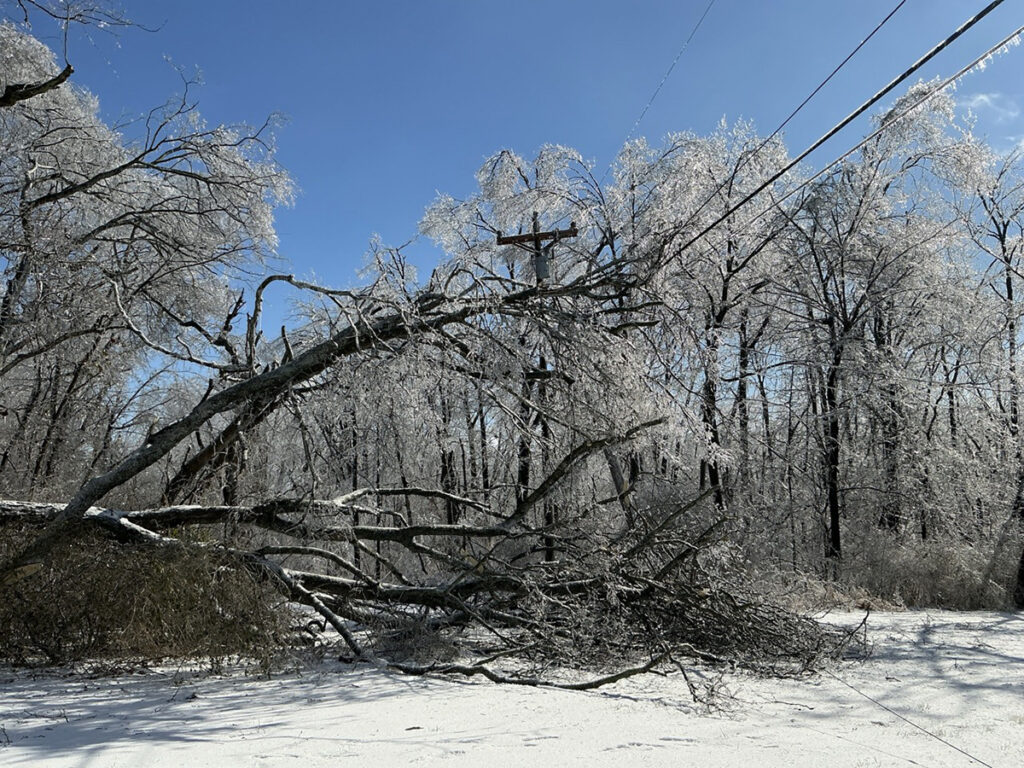
Bartley, a foreman, was just coming on duty early Sunday morning, Jan. 25, when the storm hit and he looked at his tablet in amazement as power outages in the co-op’s service territory began to skyrocket into the thousands within minutes as heavy ice damaged power lines, snapped poles and uprooted trees.
“I thought, uh-oh, here we go,” said Bartley.
For Bonds, who had been on call the night before, the realization of just how bad it would get came as he ventured out on a Bobcat to see the initial impact of the storm near the co-op’s Williamson County office.
“I called a foreman to meet me out there,” he said. “There were lines down, poles broken. We turned around to go back to the office and a tree fell between us. We were cutting and cutting with chainsaws just to be able to drive. It got pretty wild out there.”
And that was just the first hour of an ice storm that hit Tennessee—and Middle Tennessee Electric—especially hard. Nationwide, Winter Storm Fern caused more than 1 million Americans to lose power as it impacted more than half the nation, from New Mexico to Maine.
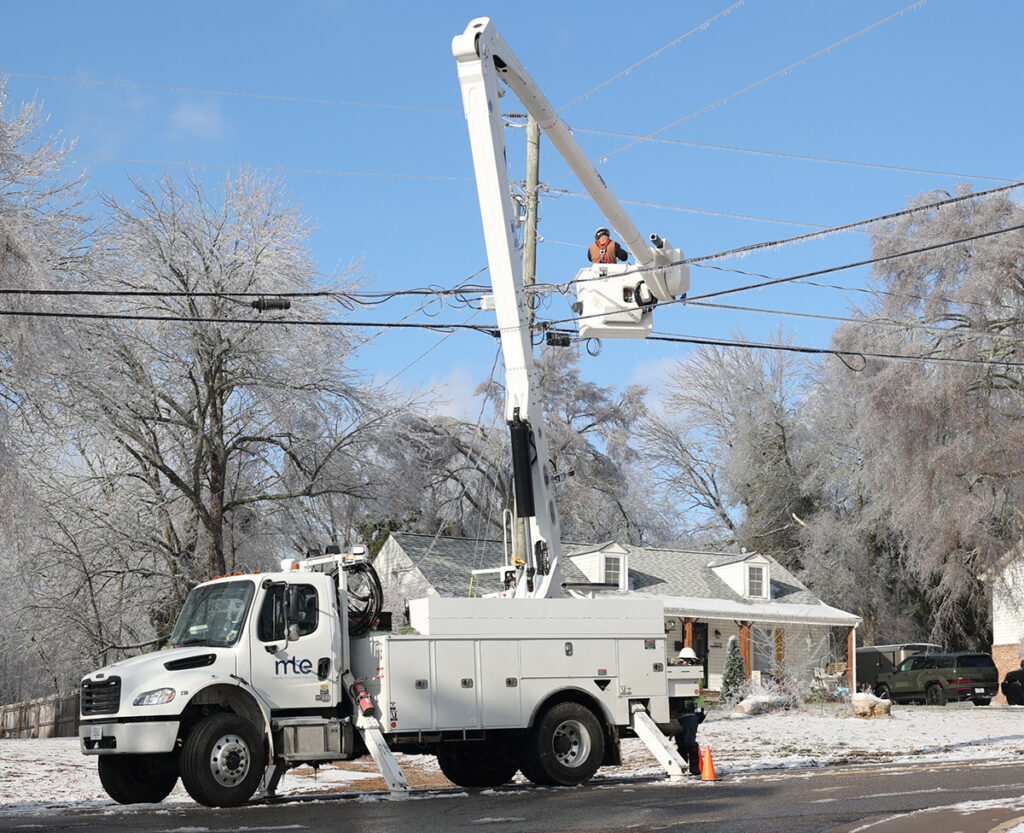
Over the next several days, Bartley, Bonds and the rest of the co-op’s 150 lineworkers took turns working 16-hour shifts in frigid temperatures, making their way along slippery roads covered with trees and branches to fix sagging power lines and replace broken poles.
“With all that ice and debris, you can’t get a truck in,” Bonds said. “You’ve just got to go in and climb the pole. You’re out in the woods, and you’re up on a pole and you hear stuff breaking around you. There’s nothing to stop a tree from falling while you’re working. It’s scary, but it’s an inherent risk of the job.”
As Bartley put it, “you’ve got to have your head on a swivel, looking around to take in what’s happening as you’re working, especially when you’ve got trees popping and dropping in the background.”
“You’ve really got to be on your game when it comes to safety,” he said. “We all want to go home to our families.”
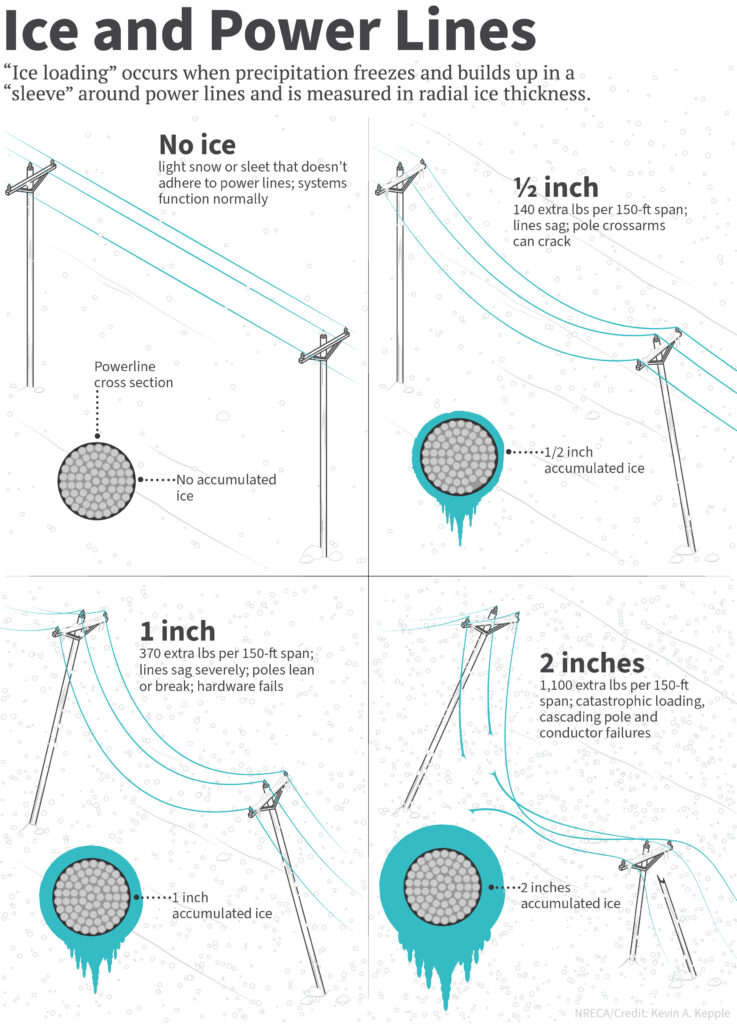
Restoring power in an ice storm like Fern is especially tough because ice can go on causing damage to an electric grid for days after the storm hits, especially when temperatures remain too low to allow melting, Bartley said.
“We go in and put a power line back up or change out a pole, but a tree can still fall on the line later and tear it all back down,” he said. “It gets very frustrating. When it’s a tornado or a hurricane, we can go in afterward and fix it and it stays fixed. But an ice storm is so unpredictable that you don’t know what’s going to happen. Sometimes, you feel like you’re fighting a losing battle.”
But it was a battle that the MTE line crews ultimately won in a surprisingly short amount of time. With help from 400 to 500 contractors and mutual aid crews, the co-op had restored power to 99% of its initial 30,000 outages by Tuesday, Jan. 27, when many utilities affected by Fern still had significant outages that would take days or even weeks to restore.
“It was the largest mobilization of mutual aid that we have ever had in our 90-year history,” said Chris Jones, CEO and president of the 350,000-member co-op based in Murfreesboro. “Everyone worked together extremely well and got it done very quickly. And I’m especially thankful that there were no significant injuries.”
He said the key was advance planning, with co-op leaders meeting daily, starting about five days before the storm was expected to batter the state.
“We would talk about updated weather forecasts and make sure we were all on the same page on work shifts and who to contact,” Jones said. “Having the groundwork already laid really helped.”
After the storm hit, the co-op’s communications team updated members on social media about the outage situation every hour on the hour, and Jones recorded videos that were posted at the end of each day to tell members what to expect next.
“It was a real team effort, and I couldn’t be prouder of everyone,” Jones said. “It was a crash course in who we are. The storm brought us together in a way that few things can. As difficult as it is to get through, there are always benefits to persevering through something like this and proving that we can do it together.”
Bartley and Bonds said co-op members showed appreciation for their efforts.
“It’s very rewarding when a member comes out to thank us,” Bartley said. “Some come out crying. And the kids draw us pictures and write letters telling us how thankful they are and saying they want to be linemen when they grow up. It means a lot.”
Bonds said that he and other lineworkers feel an adrenaline rush that keeps them going during the long hours of restoring power in bone-chilling cold.
“You think about if it was a member of your own family, your own kids, how much it would mean to you to get your power back,” said the married father of three. “It makes it that much sweeter when the lights come on again.”
Erin Kelly is a staff writer for NRECA.
Related Content:
‘The Infrastructure Just Can’t Bear It’: Weather Veterans Weigh in on the Power of Ice, Wind
Q&A With NRECA’s Safety Head on Winter Storm Fern’s Power Restoration Challenges